Introduction to .NET Framework
Introduction to .NET Framework
M.SARULATHA
Assistant Professor,
Dept. of CA, JJC.
.NET is a framework for software developed and
developed by Microsoft. The first version of the .Net framework was 1.0 which
arrived in 2002. In simple terms, it is a visual design and programming machine
written in various languages such as C #, VB.Net etc.
It is used
to improve Form-based applications, web-based applications, and Web services.
There are various editing languages available on the platform .Net, VB.Net
and C # have become the most common. Used to build applications for Windows,
phone, web, etc. It offers a lot of functionality and also supports industry
standards.
The .NET
framework supports more than 60 programming languages in which 11 programming
languages are designed and developed by Microsoft. Non-Microsoft
non-Microsoft languages are supported by .NET Framework but are not designed
and developed by Microsoft.
The
11 Design Languages designed and developed by Microsoft are:
• C # .NET
• VB.NET
• C ++. NET
• J # .NET
• F # .NET
• JSCRIPT.NET
• WINDOWS POWERSHELL
• IRON RUBY
• IRON PYTHON
• C OMEGA
• ASML (Killing Machine Language)
NET elements Framework
Standard
Language Operating System (CLR): CLR is the basic and visible form factor of
the .NET framework. It is a time spent on NET A framework that uses coding and
helps to simplify the development process by providing a variety of services
such as cash withdrawals, cable management, type security, memory management,
power, etc. Basically, it is responsible for managing the implementation of
.NET programs in any NET language. It is also useful for code management, as
the target code is known as the Managed Code and the non-target code is known
as the uncontrolled code.
Frame
Class Library (FCL):
A collection of redesigned, high-quality libraries, etc. Combined with CLR.
Also called Assemblies. It's just like header files in C / C
++ and packages in java. Installing the NET Framework is basically the
inclusion of CLR and FCL in the system. Below is an overview of the .NET
Framework.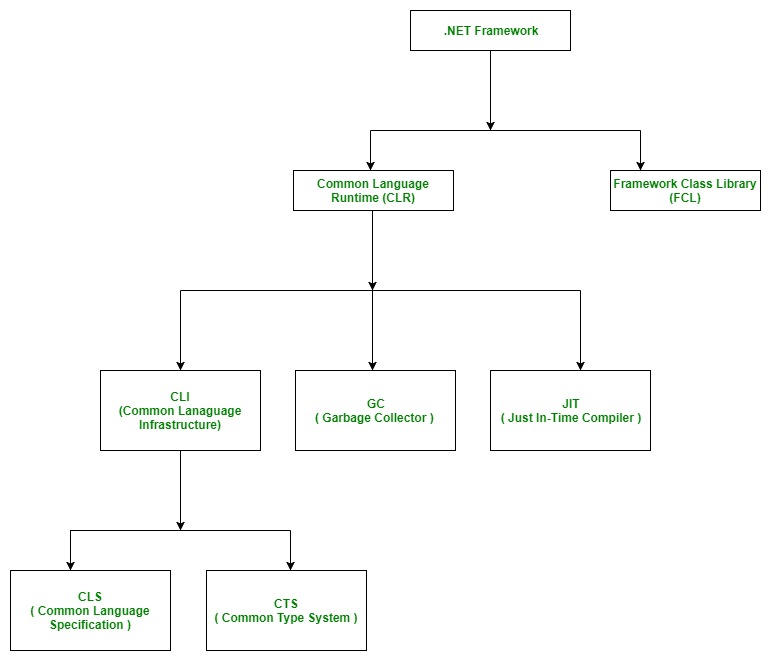
Is the .NET application platform reliable or is the
platform independent?
The combination of Operating System Architecture
and CPU Architecture is known as the platform. Platform dependence means that
the programming language code will only work on a specific Operating system.
The .NET application relies on a platform due to the .NET framework that can
only work on the Windows operating system. Application .It is not a standalone
platform and due to the Mono framework. Using the Mono framework the .Net
application can work on any application that includes windows. The Mono
Framework is a third-party software developed by Novell Company which is now
part of the Micro Focus Company. It is a paid framework.
version
of .NET Framework with the different
Windows version
|
.NET VERSION |
CLR VERSION |
DEVELOPMENT TOOL |
WINDOWS SUPPORT |
|
1.0 |
1.0 |
Visual Studio .NET |
XP SP1 |
|
1.1 |
1.1 |
Visual Studio .NET
2003 |
XP SP2, SP3 |
|
2.0 |
2.0 |
Visual Studio 2005 |
N/A |
|
3.0 |
2.0 |
Expression Blend |
Vista |
|
3.5 |
2.0 |
Visual Studio 2008 |
7, 8, 8.1, 10 |
|
4.0 |
4 |
Visual Studio 2010 |
N/A |
|
4.5 |
4 |
Visual Studio 2012 |
8 |
|
4.5.1 |
4 |
Visual Studio 2013 |
8.1 |
|
4.5.2 |
4 |
N/A |
N/A |
|
4.6 |
4 |
Visual Studio 2015 |
10 v1507 |
|
4.6.1 |
4 |
Visual Studio 2015
Update 1 |
10 v1511 |
|
4.6.2 |
4 |
N/A |
10 v1607 |
|
4.7 |
4 |
Visual Studio 2017 |
10 v1703 |
|
4.7.1 |
4 |
Visual Studio 2017 |
10 v1709 |


Comments
Post a Comment